Key takeaways
Proper Lighting on Tennis Courts has to do with protecting players, not in terms of the brightness of the tennis court itself, but in terms of player performance, comfort, safety.
Glare has been anytime that occurs, of aiming badly, or fitting bad fixtures, and bad layouts , and not from any lack of wattage.
Modern LED systems with good optics can increase visibility and increase energy efficiency and minimize player and neighbor complaints.
Bringing in experienced designers and installers early helps to avoid expensive rework and long-term frustration.
Why Glare Control is Important for Competitive Tennis
If you play or manage tennis courts, you are already familiar with the feeling. You throw the ball to serve the ball and look up and suddenly you lose it in a hot spot in bright lighting. That is glare in the most basic form: light shining straight into your eyes rather than onto the court.
There are two types. Being annoyed by the discomfort of glare, makes you squint. Disability of glare actually prevents you from seeing what you apply the ball or the lines. Both are detrimental to the performance of the players.
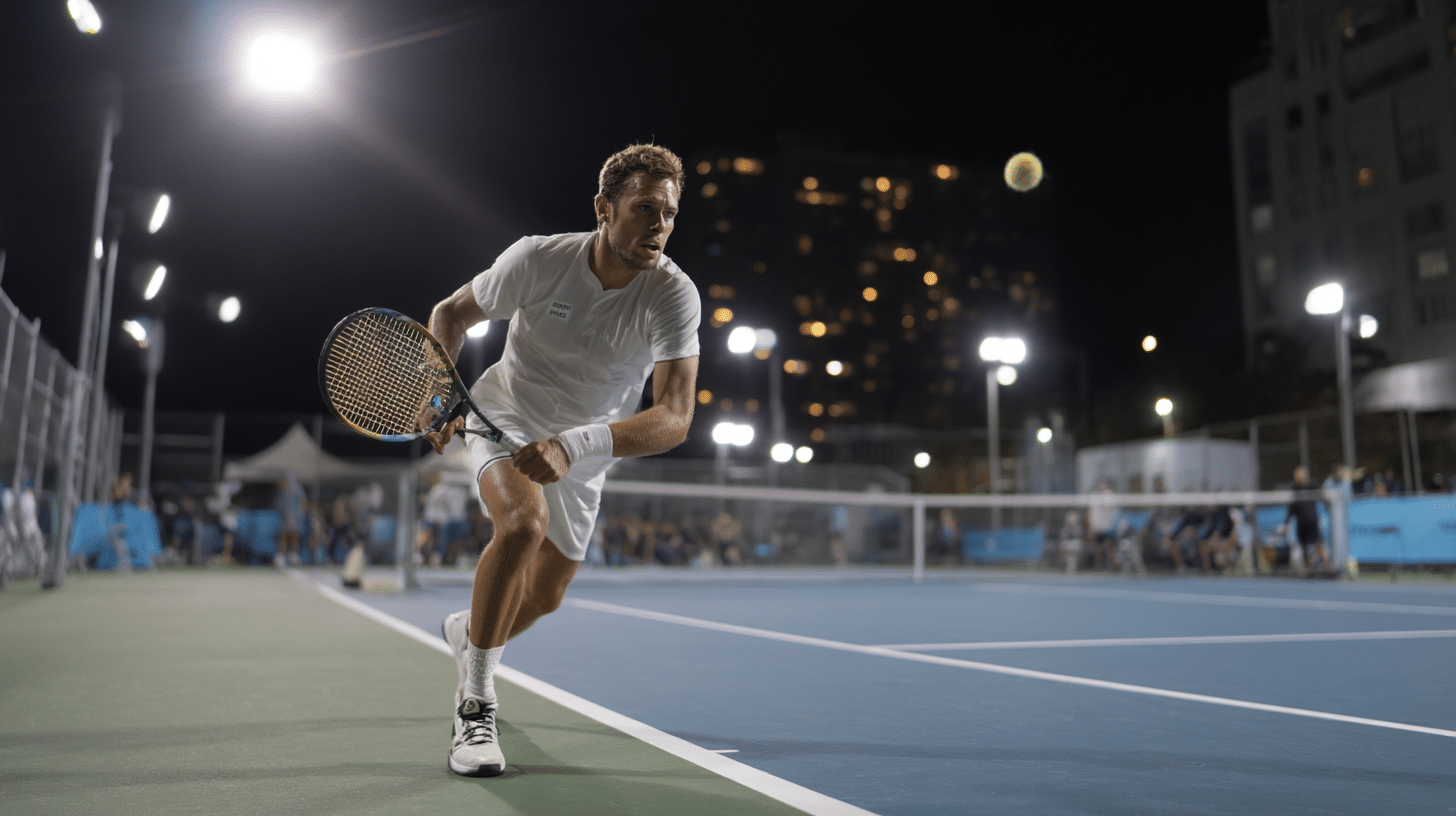 I have watched a high school match in which three double faults in succession were committed on one side of the court. The coach finally said "We stay away from that side at night." That's a lighting problem not a serving problem.
As the players are unable to keep track of overheads or lobs, they fall back. Rally quality goes down, also confidence.
I have watched a high school match in which three double faults in succession were committed on one side of the court. The coach finally said "We stay away from that side at night." That's a lighting problem not a serving problem.
As the players are unable to keep track of overheads or lobs, they fall back. Rally quality goes down, also confidence.
Important Lighting Principles for Complete Tennis Courts
You do not have to be an engineer but a few basics help. Light level is normally expressed in lux. Recreational play may be around 200 , 300 lux. Competitive club or school matches often aim for 400-600 lux with good uniformity so that the players can move where they wish without sudden changes.
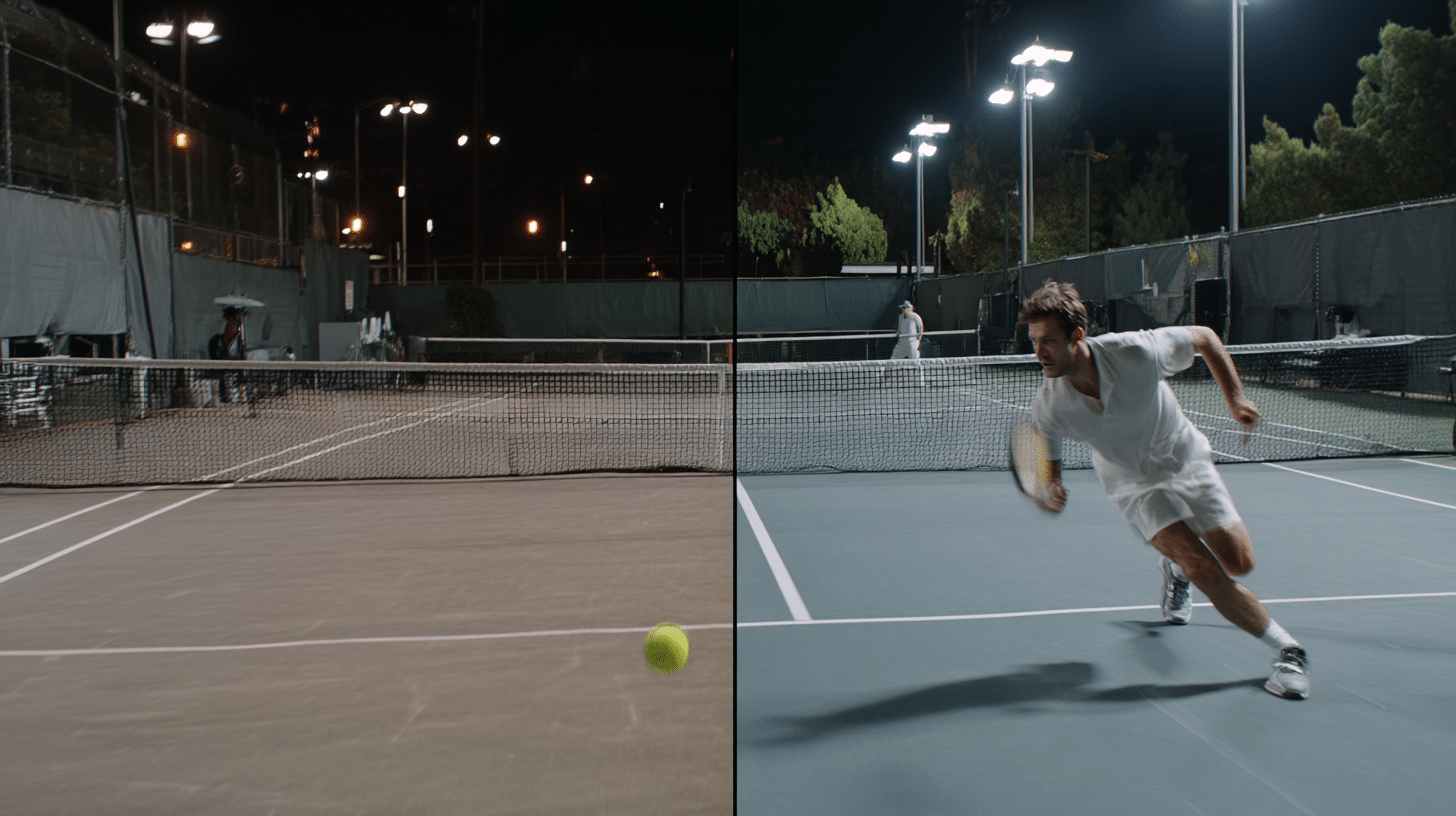 Returning to the point of litmus test objects, uniformity refers to how evenly that light is spread. If an area is twice the brightness of another, your eyes are in constant adjustment, with a loss of depth perception. I have walked courts where the baseline seemed like a stage and the net looked like a cave.
The
Returning to the point of litmus test objects, uniformity refers to how evenly that light is spread. If an area is twice the brightness of another, your eyes are in constant adjustment, with a loss of depth perception. I have walked courts where the baseline seemed like a stage and the net looked like a cave.
The
U.S. Department of Energy’s Sports Lighting resource outlines recommended illumination levels and uniformity standards for sports facilities. Color rendering is also important. With poor color rendering the ball and lines blend into the surface of the court. A neutral white tone that generally has decent colour rendering allows you to see spin, seams and line edges better.
When you get these basics together and get them right, players stop talking about the lights, and they just play.
Major Reasons for Glare on Tennis Courts
However, most glare issues begin with placement and aiming (rather than the brand of fixture). Poles set too close to the baselines or too low set the bright part of the beam directly in the eyes of players during their services and overheads. I have seen courts where all of the right-handed servers complained from the same corner.
Wide flood beams tend to spill light everywhere as well. Instead of straightened light distribution over the playing area, you get gliding puffs in the sky. Add too much brightness and the problem gets worse, and not better.
Older metal halide fixtures drift after a while. Lens go yellow or lamps turn dim patches not the same and you end up with bright hot spots and dark patches. Players feel it even if they are not able to explain why.
When someone says, "Let's just add two more lights," without a plan, usually, you increase glare as well as energy use, side by side.
Designing Low-Glare Tennis Court Lighting
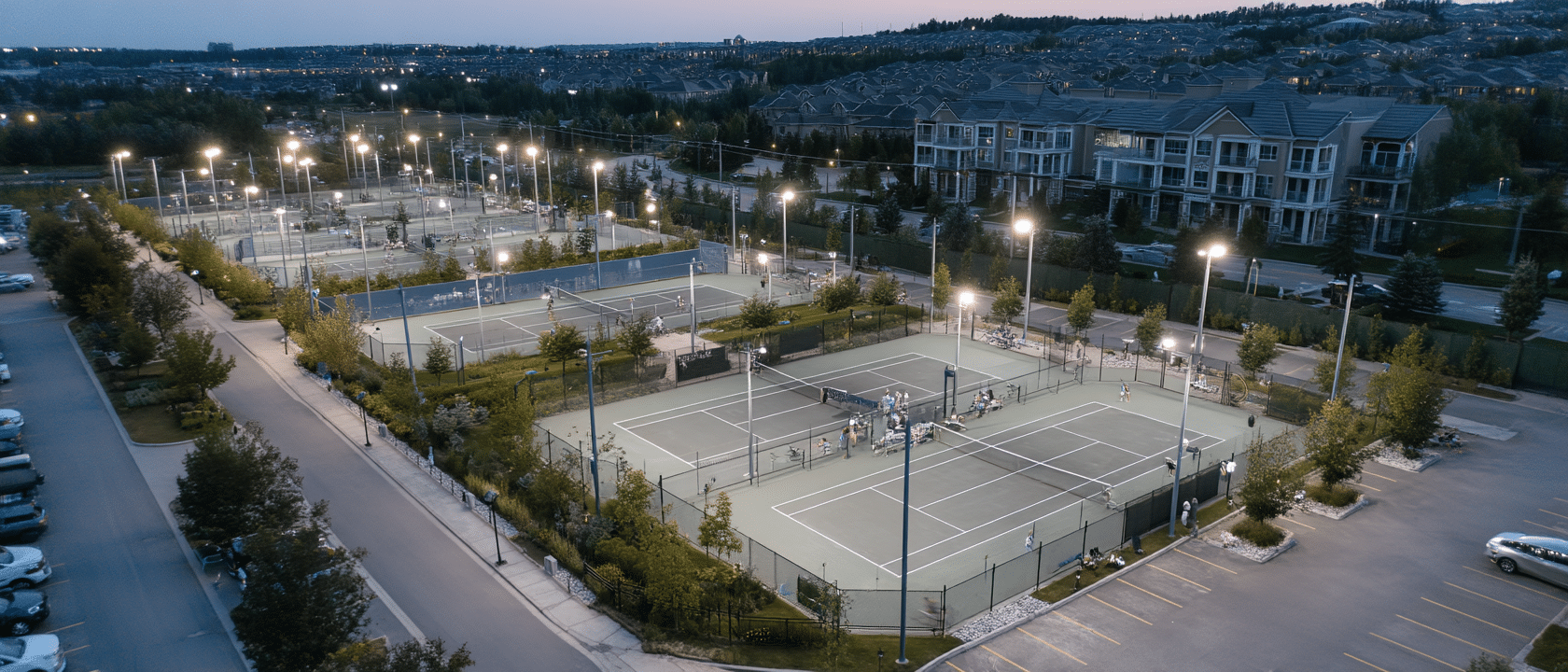
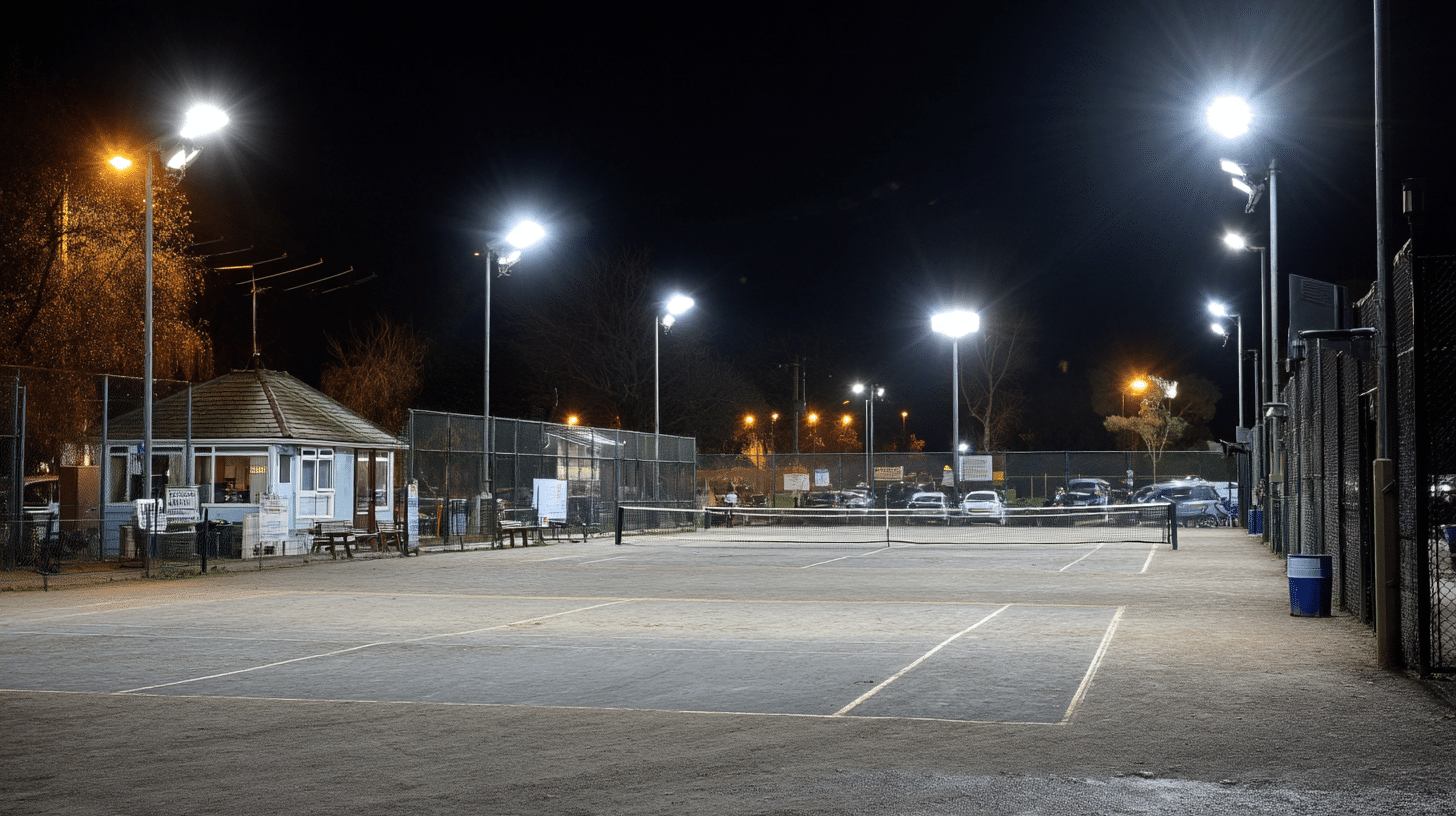
Good design begins with the layout. For the majority of tennis courts, side lighting offers superior glare-control compared to end lighting since the players do not look directly into the fixtures when serving the ball. Typical competitive layouts have a pole count from four to eight poles per court depending on level/competitive level.
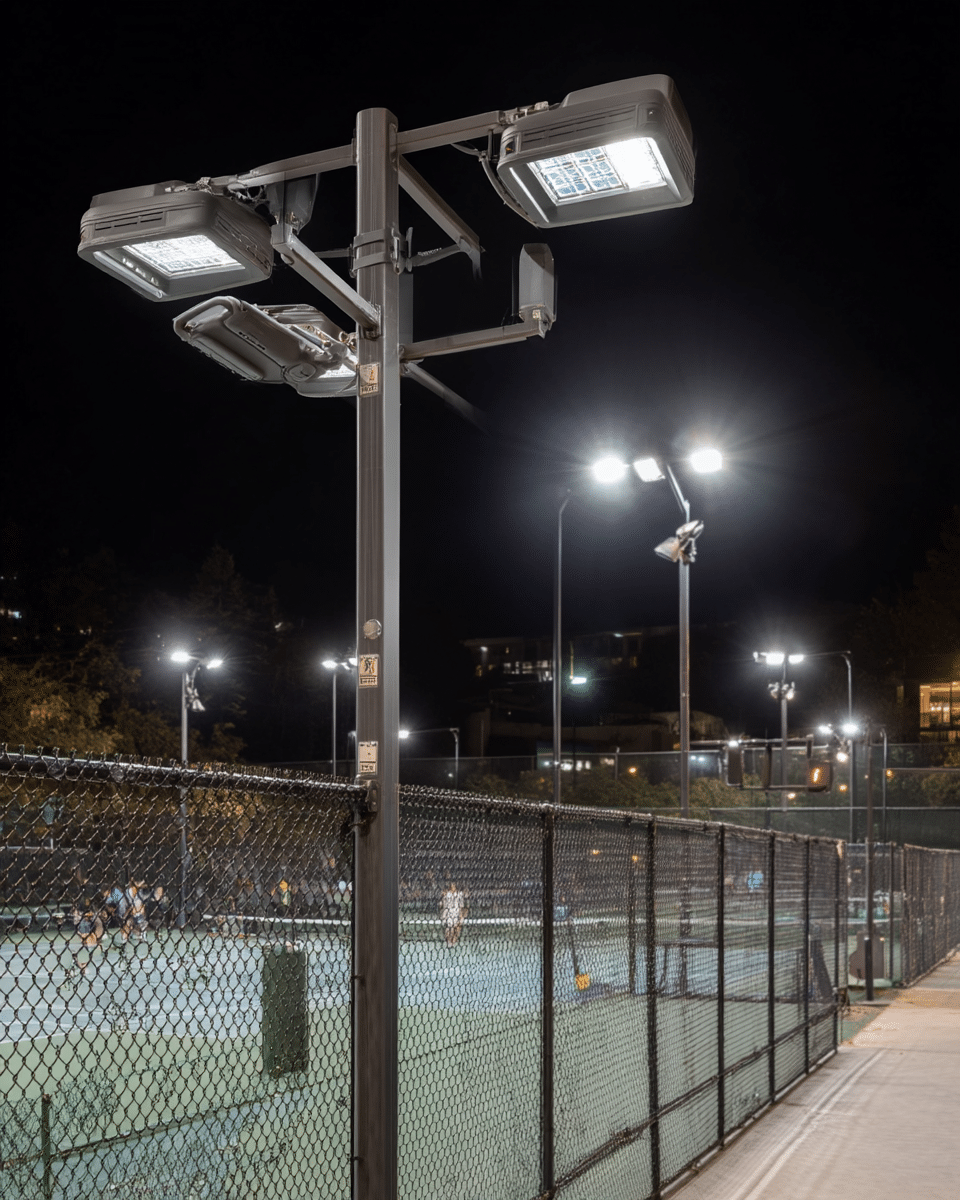
The selection of fixtures is important. Dedicated sports lighting solutions, with proper optics, control the beam so that light is where it should be , on the court and not in the eyes of the players and in the windows of the neighbors. You can customize beam angles to ensure light does not go off the sky to focus on the playing space.
 The
The
International Dark-Sky Association explains that improperly aimed or unshielded fixtures add to glare, light trespass and skyglow , all of which may create problems with visibility on the playing surface as well as annoyance to the surrounding areas. Their advice on using fully shielded luminaires and shining the light only where it is needed is supportive of the use of controlled optics and aiming carefully on tennis courts to minimize glare for both the players and neighborhood complaints.
I worked with a club where they changed out generic floodlights with modern LED sports units. On paper, total lumens went down. On court, players were saying, "I can finally see the ball at the net."
Think of design as where do you want all your lumens to go, not just how many do you buy?
Tennis Court Lighting Installation: Getting It Right the First Time
This is where the majority of the projects get lost. Someone orders some fixtures online, a local electrician installs them and everyone hopes for the best. Sometimes it works. Often it does not.
A proper
tennis court lighting installation starts with a site assessment. You take a look at existing poles and wiring and the proximity of homes and the way that players actually move. Then a designer constructs a photometric plan which makes predictions of lux levels, uniformity and aiming angles.
Through the installation, the devil lies in the details: pole foundations, alignment on the bracket, weather-proof connections, and safe routing. The final step should always be night time aiming. I like to go to the baseline and watch a couple of serves, and adjust angles until I see observers coming out of glare and problems.
When you treat tennis court lighting installation as a one-time box to check, you usually pay for it later in complaints and callbacks.
Controlling Glare Through Smart Lighting Controls
Controls are often placed in later afterthought but can be a quiet way of diminishing glare and costs. And sometimes you do not need 100% of the output. For practice or youth clinics you can go down to 60 to 70 percent. That reduces brightness, reduces eyestrain and increases fixture life.
Zoning helps too. If you are using only one court, then there is no rational reason to flood three empty tennis courts with three full-power lighting installations. Less spill light means less distractions to the players and less to neighbors.
Remote controls or simple scheduling to change the over-time. There is one of my facility managers who used to climb a ladder to flip breakers. Now he is tampering with levels from his phone after watching a match from the spectator area. Small change, big difference as to how the lighting system actually gets used.
Maintenance Practices that Keep Glare under Control
Even the best of designs gets lost if you don't maintain maintenance. Dust, insects and weather film accumulations are on the lenses and add to the scattering which feels like additional glare. A quickened cleaning schedule twice a year perhaps means that things are closer to the original design.
 Storms and vibration can cause fixtures to knock out of alignment. One court that I went to had one head twisted a few degrees after a windstorm. Players on that side were complaining about a "spotlight" effect. A ten minute re-aim fixed weeks of aggravation.
Once in a while I walk the courts at night. Stand where players stand. Ask them whether they ever kick lose the ball in certain corners. Those informal checks process changes before they become larger problems in the form of complaints or safety issues.
Storms and vibration can cause fixtures to knock out of alignment. One court that I went to had one head twisted a few degrees after a windstorm. Players on that side were complaining about a "spotlight" effect. A ten minute re-aim fixed weeks of aggravation.
Once in a while I walk the courts at night. Stand where players stand. Ask them whether they ever kick lose the ball in certain corners. Those informal checks process changes before they become larger problems in the form of complaints or safety issues.
Return on Investment (ROI) and Budgeting Planning for Low Glare Tennis Lighting
Upgrading
tennis courts is not cheap; and I think it is fair to say most budgets are tight. Metal halide systems may appear to be less expensive initially, but consume more power and require frequent lamp and ballast replacement. Modern LED lighting with good optics usually reduces energy consumption by 40-60 percent and with a longer life-time.
 For a small complex, that can result in payback in a few years, especially when you grab utility rebates. One club I worked for used local incentives very well funding almost a quarter of their upgrade.
There is also the revenue side of this. Better visibility and comfort keep courts busy till later in the evening. Where they are playing, leagues prefer no glare complaints from the players. That is harder to measure, but owners know when they see an increase in bookings.
For a small complex, that can result in payback in a few years, especially when you grab utility rebates. One club I worked for used local incentives very well funding almost a quarter of their upgrade.
There is also the revenue side of this. Better visibility and comfort keep courts busy till later in the evening. Where they are playing, leagues prefer no glare complaints from the players. That is harder to measure, but owners know when they see an increase in bookings.
How To Assess Current Tennis Court Lighting
You can learn so much in one evening. Walk each court during play. Stand at both baselines and look up at your normal serve toss of serve to see where the fixtures are in your eye. If you command the urge to shield your eyes, that's a red flag.
Watch a few rallies either from the net, and from the side of the spectator. On overheads, do players ever doubt to swing the ball because they do not see it obviously? Do faces appear washed out or harsh?
If you want numbers, a simple light meter or phone app can give you rough lux readings at a number of points. You are not trying to do it perfectly, just to get a sense as to whether levels and uniformity seem right.
When it seems that with the complaining getting repeated, or photos reveal bright blobs and dark corners, it is time to bring in a sports lighting specialist that can help you improve the visibility and lower the glare without any guessing.
Frequently Asked Questions
How bright does my tennis court need to be to be competitive?
For most competitive club or school tennis courts the goal is for around 400-600 lux with the luxury of adequate uniformity meaning that players can move anywhere and still see clearly.
Can I reduce glare without changing all my poles?
Sometimes. Re-aiming fixtures, adding shields or changing to better optics will help. Low or badly placed poles should be replaced if they are too low or badly placed.
Are the LED lights better for glare control than Metal Halide?
Not always but modern led fixtures with proper sports optics usually have a better control, energy efficiency and better light distribution than aging metal halide units.
How long does it typically take for a lighting upgrade?
A very simple retrofit on two outdoor courts could be considered as taking a few days if material is available. New poles and new wiring could take up to a couple of weeks.
What Is The Biggest Mistake With Tennis Court Lighting?
They go after raw brightness rather than good lighting design, overlook aiming and uniformity and discover themselves with glare that makes it more challenging to see the ball.

 CAF 2025
 Ligue 1 Algérie
 Ligue des Champions
 Ligue Europa
 Ligue 1
 Espagne - La Liga
 Angleterre - Premier League
 Italie - Serie A
 Allemagne - Bundesliga
 NBA
NBA LNB
LNB Euroligue
 Espagne Liga ACB
 Süper Lig Turquie
 Italie Serie A
 Grèce A1
 Allemagne BBL
 Édition